This article consists of two parts:
– Analysis of the game Harmsma - Groenendijk, World Championship 2025 (below)
– Analysis of the game Groenendijk - Harmsma, Dutch Championship 2025
In early June 2025, I made my debut at the World Draughts Championship in Yaoundé, Cameroon. I qualified for this World Championship through the World Cup ranking, which is a different qualification route from the one normally used. Most players qualify for the World Championship via the continental championships.
The World Cup tournament in Lishui, China, in 2024 was an important event for me in order to move up the World Cup ranking and possibly secure a place at the World Championship. The tournament did not go well, but I had probably scored enough points to qualify for the 2025 World Championship.
In 2025 it became clear that the World Championship would be held in Cameroon. Many players eventually decided not to participate. For example, there were no players from Asia, and former world champions Alexander Shvartsman and Yuriy Anikeev also chose not to travel to Cameroon. Nevertheless, the field remained strong, with many top players from Africa, Europe, and the Americas.
To arrive at the start in good shape, I deliberately reduced my study load during the final two months before the World Championship. Most of my preparation consisted of intensive training. I had many training sessions and, shortly before the championship, I attended a training camp at Papendal. My preparation also included playing the Bourges Open, and I made sure to maintain good physical condition. This was important not only to cope with a demanding tournament that could last up to three weeks, but also to be prepared for the heat in Cameroon.
Due to the many withdrawals, the FMJD decided to organize the World Championship with 40 participants instead of 48. As a result, the groups were smaller, increasing the chances of finishing in the top three of the group and qualifying for the final.
The World Championship was an extremely valuable experience, not only because of the sporting challenge and the tension of the group stage, but also because of the opportunity to experience the culture — and especially the draughts culture — in Cameroon. One evening, for instance, a band played during dinner, the opening and closing ceremonies were full of dance and music, dozens of people attended our visit to a local draughts club in Yaoundé, and everywhere in the streets you could see people playing draughts.
The tournament
Initially, the games were to be played in a large tent on the hotel grounds, but this was eventually changed to the hotel’s dining hall. Because the power supply sometimes failed, during the first rounds some games were played with additional light from flashlights. Fortunately, after a few rounds this was resolved, and from then on the games could always be played in daylight.
In the group stage, I unfortunately started with a loss against Wouter Sipma. The following day, I was able to recover with a draw against Guntis Valneris and a solid win against Jan van Dijk. I then went on to defeat Sayouba Kiema and Arnauld Kombila Mamboundou and narrowly escaped with a draw against Alessio Scaggiante. In the final round, a draw against Alain Fezeu was sufficient for qualification. It was not a good game, but I managed to secure the draw and thus qualify for the final.
No fewer than nine Dutch players qualified for the final, joined by Joel Atse from Ivory Coast, Mukendi Reagan Lutete from the Democratic Republic of the Congo, and Guntis Valneris from Latvia. Unfortunately, I started the final stage with a disadvantage, as the results against the other finalists from the group stage were carried over.
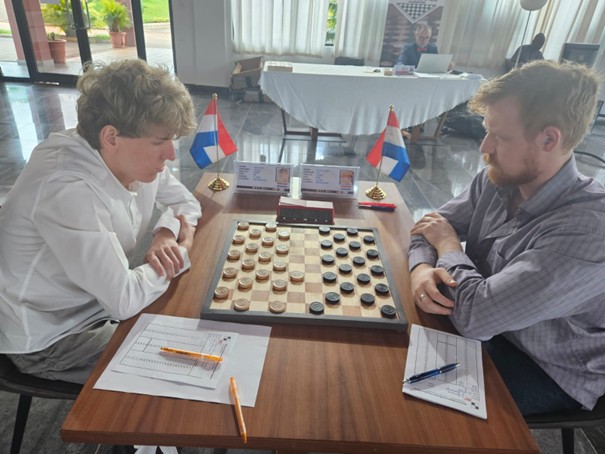
In the final, I did not manage to finish higher than twelfth place. Nevertheless, I was satisfied with most of my games. My best game was the one against the eventual world champion, Jan Groenendijk.
This game was special, as Groenendijk had hardly been in trouble during the World Championship and yet reached a practically lost position against me. During the game, I did not realize how good my position actually was, although I did feel that I had missed a better continuation at some point. The opening setup was tense, and due to time pressure around moves 35 to 45, it became a very exciting game.